

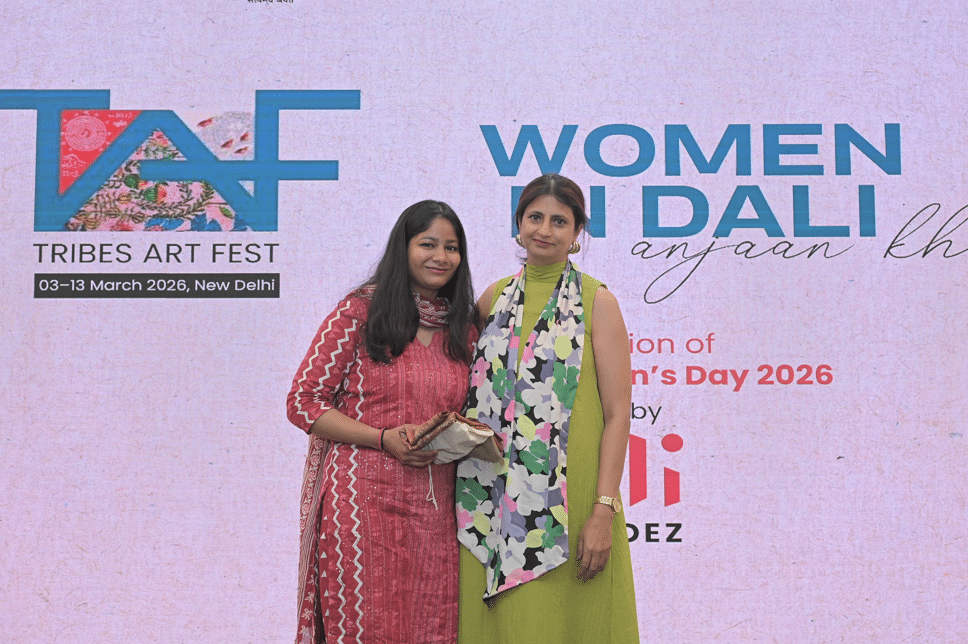
Travancore House, New Delhi
On 8 March 2026, Travancore House in New Delhi became a space for reflection, dialogue, and recognition as Women in Dali – Anjaan Khushi marked International Women’s Day. The gathering was part of the Tribes Art Festival and brought together artists, scholars, and cultural voices in a setting that encouraged both engagement and quiet observation. The initiative, hosted by Dali Art Studio, focused on creating a platform where artistic practice and personal experience could come into conversation.
The programme was organised in collaboration with FICCI, the Ministry of Tribal Affairs, and the National Gallery of Modern Art. Together, these institutions contributed to an evening that centred on recognising women artists and the diverse journeys that shape their work. Rather than a conventional exhibition format, the event created a shared space for exchange—between artists, audiences, and ideas.
Among the six artists honoured was Himadri Gupta, whose practice stands apart for its use of textile, embroidery, and threadwork. Instead of working with paint on canvas, she builds her images through fabric and stitched surfaces. This choice of medium is not only aesthetic but also conceptual. It reflects a slower, more deliberate way of making—one that mirrors the nature of the stories she chooses to tell.
Himadri’s work often explores the relationship between the exploitation of women and the exploitation of nature. For her, these are not separate concerns. Both are rooted in systems that overlook care, labour, and sustainability. Through the use of thread, she creates surfaces that feel both fragile and strong. The materials carry a sense of intimacy, but they also hold weight in what they communicate.
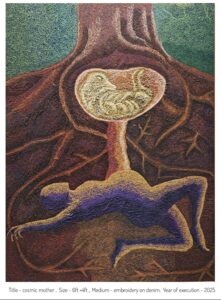
Her approach to art is deeply influenced by personal memory. Growing up, she observed the life of her mother, a housewife, whose work remained largely invisible in the public eye. From the outside, it appeared ordinary. But for Himadri, it raised important questions about recognition and value. Who tells the stories of women whose lives unfold within domestic spaces? And how can these stories find a place within contemporary art?
These questions became central to her practice.
Over time, she began working with textile and embroidery as a way to translate these reflections into visual form. Stitch by stitch, her work builds narratives that are both personal and collective. The act of sewing itself becomes significant—it reflects patience, repetition, and care. Each piece evolves gradually, allowing the process to remain visible within the final work.
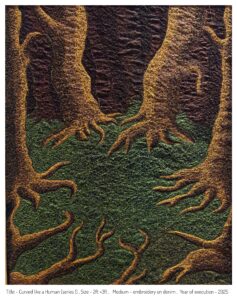 This method also shapes the way her work is experienced. Unlike more immediate visual forms, her pieces invite viewers to slow down. The details reveal themselves over time. Threads intersect, textures shift, and meanings unfold quietly. In this way, her work resists quick interpretation and instead encourages sustained attention.
At Women in Dali – Anjaan Khushi, her felicitation acknowledged not only the distinctiveness of her medium but also the depth of her ideas. Within the context of the event, her work contributed to a larger conversation about how women’s experiences are represented—and often overlooked—within cultural narratives.
The evening itself reflected this spirit of engagement. It moved at a measured pace, allowing space for both interaction and reflection. Audiences were not only viewing artworks but also engaging with the processes and stories behind them. This approach reinforced the idea that art is not limited to the finished piece; it is equally about the journey of making and the experiences that inform it.
In this context, Himadri Gupta’s work found a natural resonance. Her practice does not seek to make grand statements. Instead, it focuses on the subtle and the overlooked. It brings attention to lives that are often seen but not fully acknowledged. Through her use of textile and thread, she creates a language that is both accessible and layered.
Her work ultimately reminds viewers that meaning can emerge from the most familiar spaces. Everyday life, when observed closely, carries its own depth and complexity. By translating these observations into art, she creates a space where such experiences can be recognised and valued.
To explore more about the initiative and upcoming exhibitions, you can also visit Dali’s Instagram page.
Read more about Women in Dali here: Women in Dali